One Day to Change Every Day
What Global Accessibility Awareness Day Means in 2026
GAAD falls on the third Thursday of May each year. It began in 2011 when web developer Joe Devon published a blog post challenging the technology industry to spend one day thinking about the one billion people living with a disability worldwide. Accessibility professional Jennison Asuncion read it, reached out and together they turned the idea into a movement. The first official GAAD was held in May 2012. Fourteen years later it is observed across dozens of countries with the support of some of the world's largest technology companies and disability advocacy organisations.
The day has two threads. The first is digital, pushing developers, designers and product teams to examine whether their websites and applications are genuinely usable by people with visual, motor, cognitive or hearing impairments. The benchmark is the Web Content Accessibility Guidelines, WCAG, and GAAD is one of the most powerful annual prompts for teams to honestly assess where they stand. The second thread is lived experience. Events around the world bring disabled speakers and advocates into workplaces and public forums to share what exclusion actually feels like and what real inclusion looks like in practice.

The numbers behind the day are hard to ignore. The World Health Organisation estimates 1.3 billion people globally live with a significant disability. In Australia that figure sits at more than 4.4 million people. In Aotearoa New Zealand it is around 1.1 million, roughly 24 percent of the population. These are not edge cases. They are colleagues, customers, family members and community members navigating environments and digital spaces that were not built with them in mind.
Awareness alone is only valuable if it leads somewhere. The organisations doing it right treat GAAD as a checkpoint, asking not just whether they are compliant but whether they are genuinely usable by everyone who needs them. A fully accessible building means little if a wheelchair user cannot find reliable information about the accessible entrance before they travel across town. Information is access and knowing before you go matters as much as what you find when you arrive.
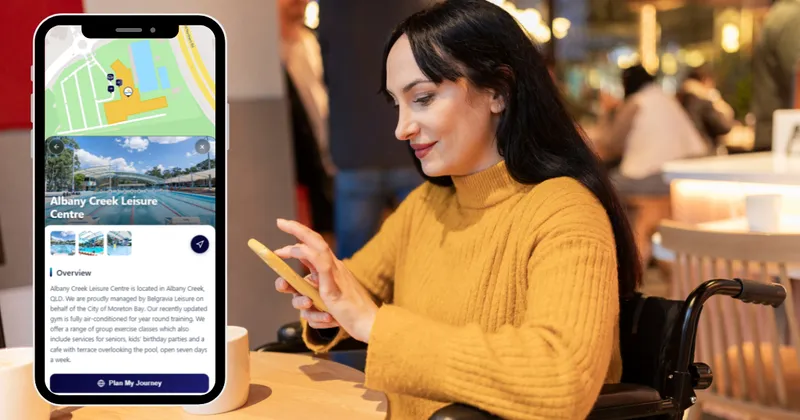
Platforms like Access Maps are built around exactly this principle, giving organisations and councils the tools to capture and publish detailed accessibility information across their spaces so that people can plan with confidence. It is the practical infrastructure that turns good intentions into genuine inclusion.
If you want to mark GAAD this Thursday, start simple. Spend an hour navigating your organisation's website using only a keyboard. Walk your physical space with fresh eyes. Ask where the gaps are and what it would take to close them.
The GAAD Foundation's full list of global events and resources is available at gaad.net.